Semuliki feels like a different Uganda. After the cool, tidy tea country around Fort Portal, the road drops toward Bundibugyo and the air changes. It gets warmer, heavier, greener. The forest closes in. The Rwenzori foothills rise behind you, the Semliki River winds toward Lake Albert, and the sounds are less savannah and more Congo Basin.
That is the main reason to visit Semuliki National Park. It is not the place for big open plains, long lion sightings, or herds of antelope spread across golden grass. It is a lowland tropical forest in the Albertine Rift, with hot springs that steam from the ground, primates moving through the canopy, forest elephants that may leave tracks but rarely pose neatly for photos, and some of the best birding in Uganda for Central African species.
For travelers building a Uganda itinerary, Semuliki is often the “should we add it?” park. The honest answer is yes, if you like forest, birds, unusual landscapes, cultural stories, and places that still feel a little tucked away. If your only goal is predictable big-game viewing, spend the time in Queen Elizabeth, Murchison Falls, or Kidepo instead. Semuliki rewards a slower eye.
Where Semuliki National Park is and why it feels so different
Semuliki National Park Uganda lies in western Uganda, mainly in Bundibugyo District, on the floor of the Albertine Rift Valley. It sits below the Rwenzori Mountains, close to the border with the Democratic Republic of Congo. The Semliki River, which helps define the Uganda and Congo border in this area, drains northward toward Lake Albert.
The park is relatively small by Uganda safari standards, at a little over 200 square kilometres. Size is not the point here. Semuliki protects the eastern edge of the great Ituri Forest system, often described as part of the Congo Basin forest. That explains its character. The park is warmer and more humid than the highland forests near Fort Portal. The trees feel taller and denser. The undergrowth can be thick. The bird calls sound different from what you hear in savannah parks.
Uganda Wildlife Authority information on the park highlights its lowland tropical forest and its connection to Central African species. That matters for travelers because Semuliki adds something that Kibale, Queen Elizabeth, and Murchison do not fully offer: a strong Central African rainforest feel without crossing into Congo.
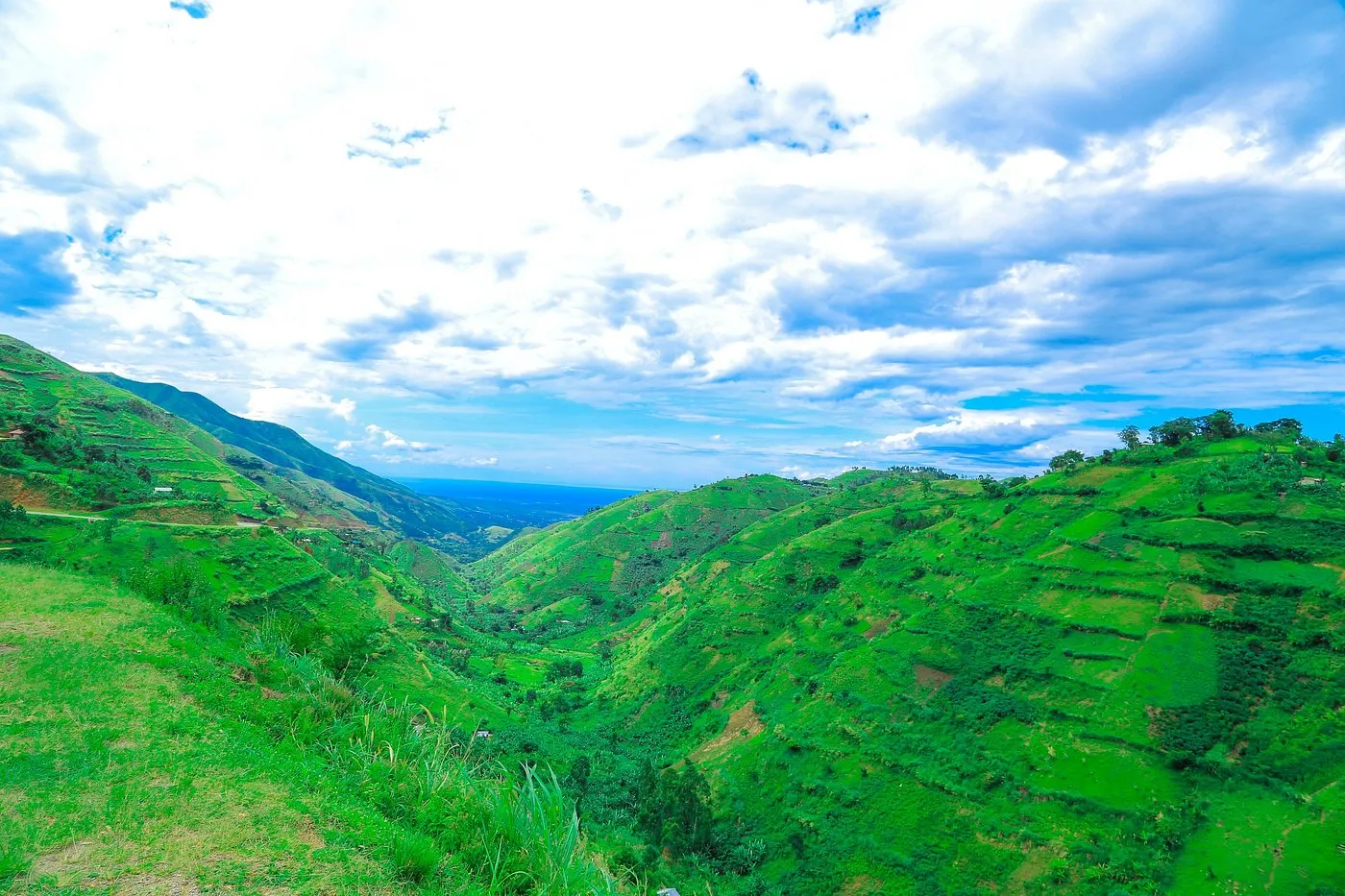
The approach is part of the experience. From Fort Portal, the road toward Bundibugyo descends from green hills and crater lake country into a hotter valley. On a clear day, the Rwenzori range can appear behind you, with forested slopes and high peaks often hidden by cloud. By the time you approach Sempaya, the landscape has shifted from highland Uganda into a darker, more tropical forest mood.
The Sempaya Hot Springs are the headline attraction
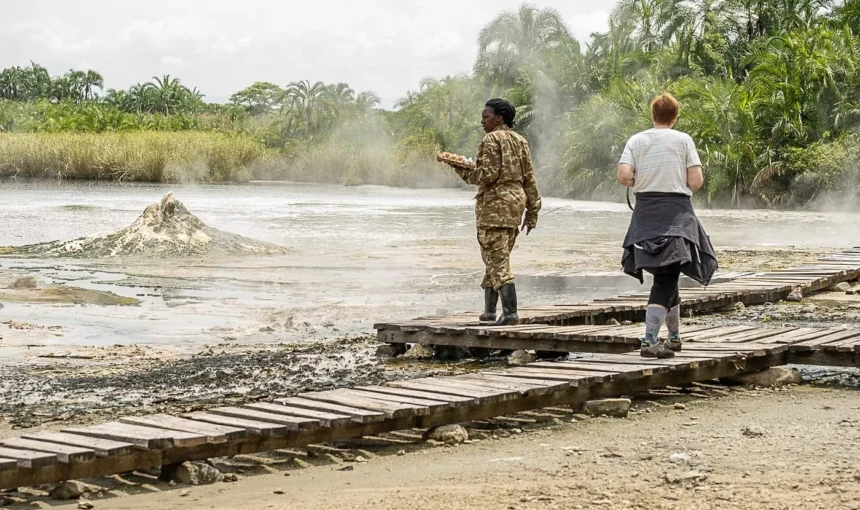
Most visitors come first for Sempaya Hot Springs, sometimes called Semuliki Hot Springs. They are the easiest and most dramatic Semuliki National Park attractions to experience in a short visit. The springs sit near the Sempaya tourism area and are reached by guided forest walks.
There are two main springs, commonly known as the male spring and the female spring. Local names and stories vary by guide and community tradition, but the most commonly shared names are Bintente for the male spring and Nyasimbi for the female spring. The cultural story often told at Sempaya connects the springs to a local couple and to spiritual beliefs held by communities around the forest. A good guide will explain the story with more nuance than a roadside summary, and it is worth listening rather than treating the springs as just a photo stop.
The female spring is usually the more visually dramatic. Steam rises from a boiling pool, and visitors often watch guides boil eggs or plantain in the hot water to demonstrate the heat. This is not a staged trick. The water is genuinely hot enough to cook food, and the steam gives the clearing a slightly unreal feel, especially in the morning.
The male spring is broader and calmer in appearance, with hot water spreading through a swampy area. It is less theatrical than the female spring, but the walk to it helps visitors understand the wetland and forest environment around Sempaya.
What the hot springs walk is really like
The standard Sempaya Hot Springs walk is not a hard trek. Most travelers with average fitness can manage it. The paths can be muddy, slippery, and humid, especially after rain, but the route is generally short and guided at an easy pace. Boardwalks and maintained trails help in some sections, though conditions change with weather and seasonal maintenance.
Expect:
- Warm, humid air, even when Fort Portal feels cool
- Short forest trails with possible mud
- Steam, sulphur smells, and wet ground near the springs
- Monkeys or birds if you move quietly
- Cultural storytelling from the guide
This is a good stop for families, older travelers who can manage uneven ground, and people who want a forest experience without committing to a long hike. Wear proper walking shoes anyway. Flip-flops make the muddy parts harder than they need to be.
Forest walks in Semuliki are about patience, not speed
A Semuliki safari works best when you slow down. Forest wildlife does not reveal itself the way savannah wildlife does. In Queen Elizabeth National Park, an elephant may stand in the open near the road. In Semuliki rainforest, you may hear branches crack, see fresh dung, or notice a dark shape vanish between trees.
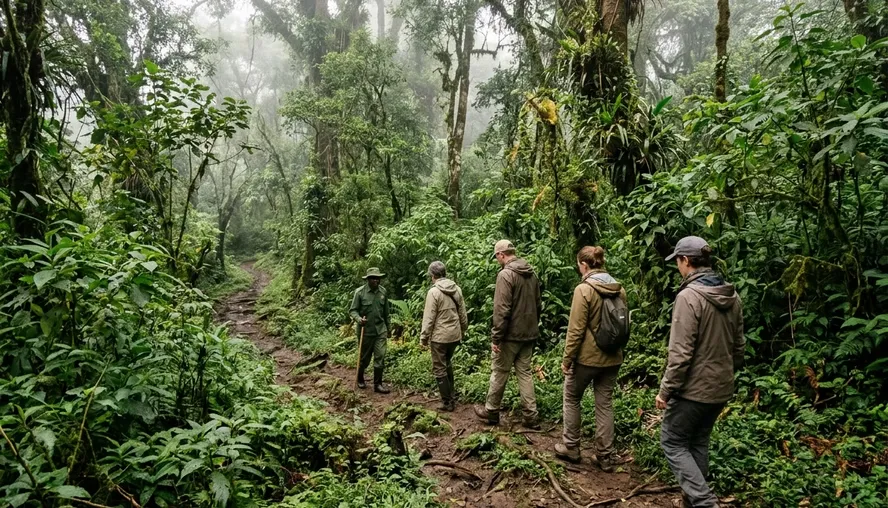
Guided forest walks are the main way to experience the park beyond the hot springs. The exact trails available can vary depending on Uganda Wildlife Authority arrangements, weather, and local conditions, but walks around Sempaya and deeper forest routes give access to primates, birds, butterflies, medicinal plants, and signs of larger mammals.
The walking difficulty ranges from easy to moderate. The challenge is rarely steep climbing. It is heat, humidity, mud, roots, insects, and the need to walk quietly. A two-hour forest walk can feel more tiring than expected because the air is heavy and the ground may be soft.
For the best experience, start early. Birds are more active, temperatures are lower, and primates may be feeding. Late afternoon can also be good, but tropical rain is common. Midday walks are possible, though the forest can feel still and hot.
Semuliki primates are exciting, but sightings are not guaranteed
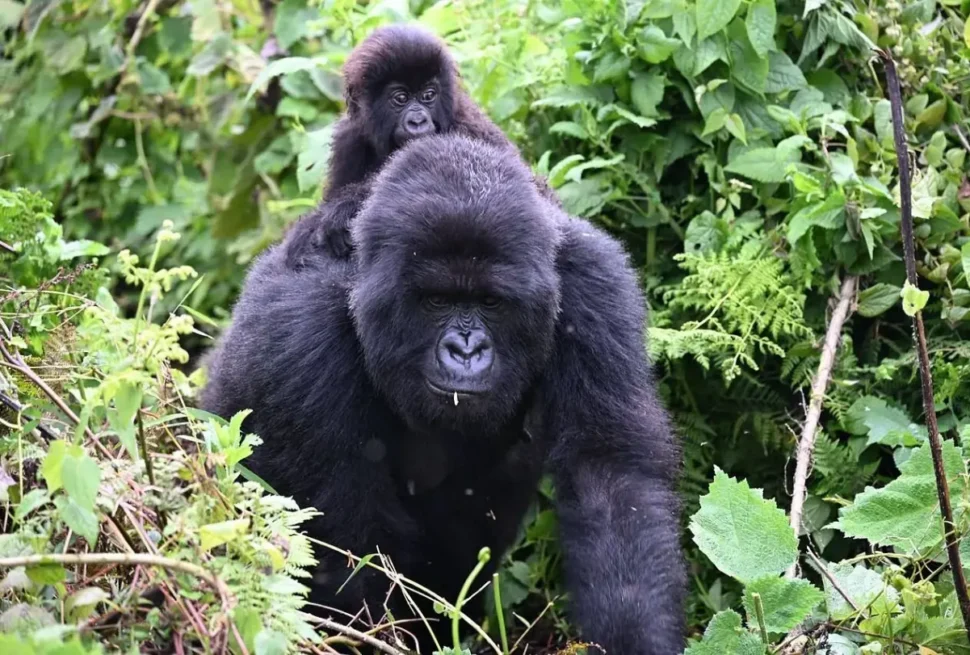
Travelers often ask about Semuliki primates because the park has an impressive species list. The forest is home to chimpanzees, red-tailed monkeys, black-and-white colobus, grey-cheeked mangabeys, blue monkeys, vervet monkeys, and several nocturnal primates such as galagos and pottos. De Brazza’s monkey is also associated with the wider Semliki Valley region, though sightings can be difficult and localized.
The key point is this: Semuliki is not Kibale. Kibale National Park is the stronger choice if your main goal is a high-probability chimpanzee tracking experience with habituated groups. Semuliki has chimpanzees, and hearing them call through the forest is unforgettable, but sightings can be unpredictable. In many cases, visitors see monkeys more reliably than chimps.
Red-tailed monkeys are among the more likely species around forest edges and fruiting trees. Black-and-white colobus are easier to notice because of their bold coats and long white tails. Grey-cheeked mangabeys can move noisily in groups, but they still require luck and a sharp guide.
A useful way to think about Semuliki primates:
| If you want | Best choice |
| Reliable chimp tracking | Kibale National Park |
| A quieter forest with mixed primates and fewer visitors | Semuliki |
| Golden monkeys | Mgahinga Gorilla National Park |
| Big forest atmosphere plus hot springs | Semuliki |
If you go into Semuliki expecting a guaranteed chimp photo, you may leave disappointed. If you go in expecting a real forest, with calls in the canopy and quick, rewarding sightings, the park makes more sense.
Semuliki wildlife includes forest elephants, buffalo and shy forest species
Semuliki wildlife is richer than many short visits suggest, but the forest hides animals well. The park is known to support forest elephants, buffalo, bush pigs, duikers, and other mammals. Leopards are present in the wider ecosystem, though rarely seen by ordinary visitors. Hippos and crocodiles are more associated with nearby waterways and the wider Semliki Valley than with the classic Sempaya forest visit.
Forest elephants are a good example of the Semuliki experience. They exist here, and their ecological role matters because elephants open paths, spread seeds, and shape forest structure. Yet visitors are more likely to see dung, footprints, broken branches, or mud marks on trees than a full elephant sighting.
That can be frustrating if you arrive with a savannah mindset. In the forest, signs are part of the story. A guide may stop to show where elephants crossed during the night, where buffalo fed, or where a duiker slipped through undergrowth. These clues remind you that the forest is alive even when it is not performing for the camera.
For big mammals on open plains, combine Semuliki with Queen Elizabeth National Park or Murchison Falls. For forest texture and rare species, give Semuliki its own place in the itinerary.
Semuliki birding is one of Uganda’s strongest specialist experiences
Semuliki birding is the park’s biggest draw for serious birders. Uganda has many excellent birding sites, but Semuliki stands out because of its Central African connections. Uganda Wildlife Authority and birding references commonly list more than 400 bird species for the park and surrounding area, including species linked to the Guinea-Congo forest biome.
This is where Semuliki becomes more than a scenic add-on. Birders come for species that are difficult or impossible to see in Uganda’s savannah parks. Depending on season, skill, and luck, the area can produce hornbills, forest kingfishers, greenbuls, flycatchers, bee-eaters, turacos, and other forest birds tied to lowland rainforest habitats.
Commonly sought species in the Semuliki area include:
- White-crested hornbill
- Black-wattled hornbill
- Red-billed dwarf hornbill
- Yellow-throated cuckoo
- Nkulengu rail
- Piping hornbill
- African piculet
- Blue-billed malimbe
- Red-rumped tinkerbird
Some of these are easier heard than seen. Dense forest birding requires patience, a good local guide, and ideally a pair of binoculars that perform well in low light. Photography can be difficult because birds move behind leaves and the canopy light is uneven. Birders should plan at least two nights nearby if Semuliki is a major focus, rather than squeezing it into a rushed half-day.
Local communities and the stories around the forest
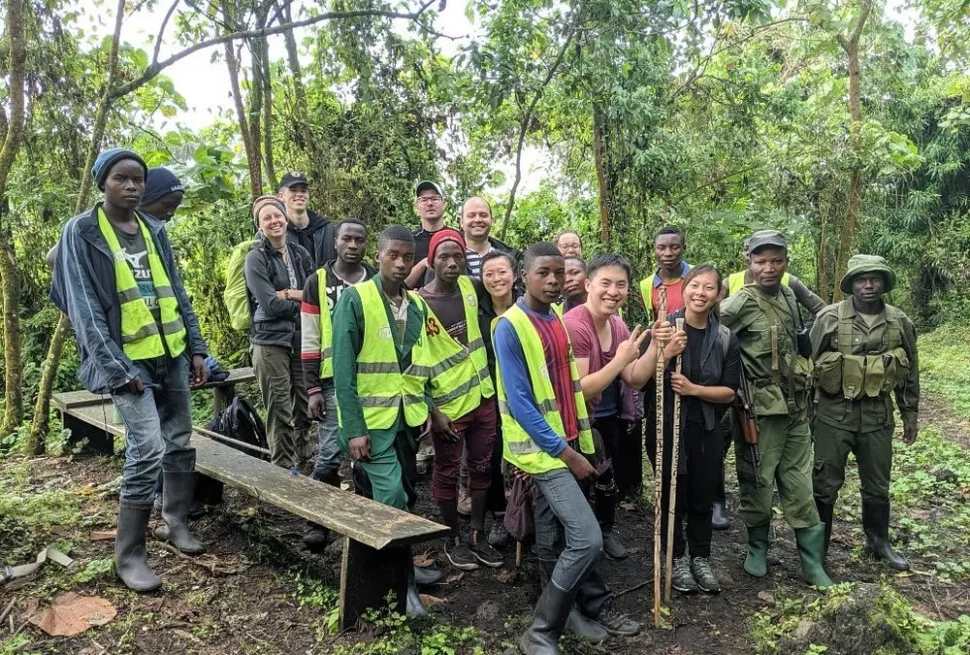
Semuliki is not an empty wilderness. The forest sits within a lived cultural landscape. Communities around the park include Bamba, Bakonjo, Batuku, and Batwa heritage groups, among others in the wider Bundibugyo and Rwenzori region. Local guides often bring important context to the forest, medicinal plants, old footpaths, hot spring stories, and the relationship between people and protected areas.
The Sempaya Hot Springs carry cultural meaning, not just geological interest. The stories of the male and female springs are part of local oral tradition, and some people regard the area with spiritual respect. Visitors should avoid treating these stories as entertainment only. Ask questions respectfully, listen carefully, and follow the guide’s instructions around sensitive places.
Community experiences near Semuliki can add depth to a visit. Depending on current local arrangements, these may include cultural interpretation, village walks, craft stops, or storytelling linked to the forest. The quality varies, so it is better to arrange community visits through a knowledgeable operator or the park office rather than rushing into a random roadside stop.
Things to do in Semuliki National Park
The best things to do in Semuliki National Park are simple, but each benefits from good timing and realistic expectations.
Visit Sempaya Hot Springs
This is the essential Semuliki experience for most travelers. It fits well into a half-day visit from Fort Portal, though staying closer allows an earlier start and more relaxed pacing.
Go for the steam, the boiling spring, the cultural story, and the short forest walk. Do not skip the guide. The explanation makes the visit far more meaningful.
Take a guided forest walk
A forest walk gives a better sense of the park than the hot springs alone. Even if wildlife sightings are brief, the forest itself is the attraction. Look for primates, butterflies, bird calls, tracks, and unusual plants.
Wear long trousers and closed shoes. Carry water. Move slowly and quietly.
Go birdwatching with a specialist guide
General guides can explain the park well, but serious birders need a guide who knows calls and local birding spots. Semuliki is a place where sound matters. Many birds are located by call before anyone sees them.
An early start makes a major difference.
Explore the wider Semliki Valley
Do not confuse Semuliki National Park with Semliki Wildlife Reserve, sometimes called Toro-Semliki Wildlife Reserve. They are separate protected areas in the same broader region. The wildlife reserve, closer to Lake Albert, has a more open valley environment and different safari possibilities.
Travelers with time can combine both for a fuller picture of the Semliki region, from lowland rainforest to rift valley habitats.
Use Fort Portal as a base
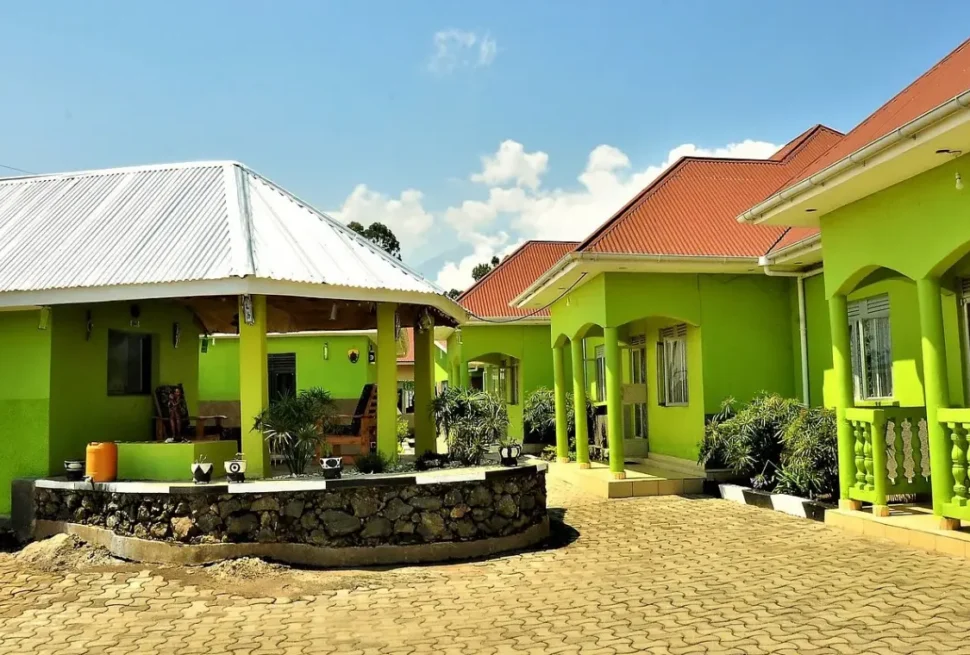
Fort Portal is the most practical base for many visitors. It has a wider range of accommodation, restaurants, fuel, banks, and access to crater lakes. From Fort Portal, Semuliki can be done as a long day trip, though it is better with an early departure.
How long to stay in Semuliki
The right length depends on your interest level.
| Time available | What you can do |
| Half day | Visit Sempaya Hot Springs from Fort Portal |
| One full day | Hot springs plus a guided forest walk |
| One night | More relaxed pacing, better early birding |
| Two nights | Best for birders and travelers who want deeper forest time |
For most general Uganda safari tours, one full day is enough to understand Semuliki’s character. For birders, one day is too short. For photographers, the forest can be challenging, so extra time helps.
A practical compromise is to sleep in Fort Portal, leave early for Sempaya, visit the hot springs, add a forest walk, and return by late afternoon. If the road and weather are favorable, this works well. If you dislike long day drives, stay closer to the park or include it while traveling toward Bundibugyo.
Best time to visit Semuliki
Semuliki can be visited year-round, but the experience changes with rain. Western Uganda has two generally drier periods, roughly June to August and December to February. These months often make forest paths easier and road travel more predictable.
The wetter periods, often around March to May and September to November, bring muddier trails and more challenging access in places. The forest looks lush, bird activity can be excellent, and photographers may enjoy the mist and deep greens. The trade-off is slippery walking and a higher chance of rain interrupting plans.
Because Semuliki is a rainforest environment, rain can fall even in the drier months. Pack as if rain is possible every day.
Heat is another factor. The park sits lower than Fort Portal, so it feels warmer and more humid. A visitor who is comfortable in the cool crater lake region may find Sempaya surprisingly hot by midday.
What to pack for a Semuliki safari
Packing for Semuliki is different from packing only for savannah drives. Think wet forest, heat, insects, and low light.
Bring:
- Lightweight long trousers
- Breathable long-sleeved shirt
- Waterproof walking shoes or sturdy trail shoes
- Rain jacket or poncho
- Insect repellent
- Binoculars
- Refillable water bottle
- Small daypack
- Camera protection for rain and humidity
- Hat for sunny clearings
- Dry bag or plastic liner for electronics
For birders, binoculars are not optional. Forest birds are often high, shaded, or partly hidden. A field guide or birding app can help, but keep sound playback responsible and follow guide advice.
Avoid heavy hiking boots unless they are already broken in. Semuliki walks are often muddy rather than mountainous, so comfort and grip matter most.
Accessibility and practical travel considerations
Semuliki is accessible, but it is not as logistically simple as Uganda’s more famous parks. Most travelers reach it through Fort Portal. The drive from Kampala to Fort Portal usually takes the better part of a day, depending on traffic, roadworks, and stops. From Fort Portal to Sempaya, allow around one to two hours depending on road conditions and weather.
The road descends toward Bundibugyo and includes winding sections. Views can be excellent, but drivers should take care, especially in rain. A 4×4 is wise for Uganda safari travel in this region, particularly if combining parks or traveling in wet months.
Park activities are guided and usually arranged through Uganda Wildlife Authority offices or through a safari operator. Fees and activity availability can change, so confirm current details before travel.
Mobile network coverage may be uneven near the park. Carry some cash for local payments, tips, and small purchases, since card payments should not be assumed. Fuel up in Fort Portal before heading down.
Health-wise, Semuliki’s lower, warmer environment means mosquitoes are more noticeable than in cooler highland areas. Travelers should seek current medical advice before visiting Uganda, especially about malaria prevention and routine travel vaccines.
How Semuliki compares with other national parks in Uganda
Semuliki makes the most sense when you understand what it does better than other parks and what it does not try to be.
| Park | Best for | How Semuliki differs |
| Kibale National Park | Chimpanzee tracking and primates | Semuliki is wilder-feeling lowland forest, but less reliable for chimps |
| Queen Elizabeth National Park | Savannah wildlife, boat safaris, lions, elephants | Semuliki is forest-focused with fewer open wildlife sightings |
| Murchison Falls National Park | Big game, Nile boat cruise, waterfall scenery | Semuliki is smaller, quieter, and more specialized |
| Rwenzori Mountains National Park | High-altitude trekking and mountain scenery | Semuliki sits below the range in hot lowland forest |
| Bwindi Impenetrable National Park | Gorilla trekking | Semuliki has no gorilla trekking, but a different Central African forest feel |
If this is a first Uganda wildlife safari and time is short, Semuliki may not be the first park to choose. If the itinerary already includes Kibale, Queen Elizabeth, and Murchison, Semuliki adds contrast rather than repetition.
That contrast is valuable. Many Uganda itineraries move from one savannah or primate location to another without showing how varied western Uganda really is. Semuliki changes the rhythm.
How to combine Semuliki with Fort Portal, Kibale, Rwenzori, Queen Elizabeth and Murchison Falls
Semuliki fits naturally into western Uganda circuits. The key is to avoid cramming too much into one day.
Fort Portal and Semuliki
This is the easiest pairing. Stay in Fort Portal, visit crater lakes and tea estates, then spend a day at Sempaya Hot Springs and the forest. Fort Portal gives comfort and flexibility, while Semuliki provides the jungle feel.
Kibale National Park and Semuliki
Kibale and Semuliki work well together because they offer different forest experiences. Kibale is better for structured chimpanzee tracking. Semuliki is better for lowland rainforest atmosphere, hot springs, and Central African birding.
A good plan is two nights near Kibale, then one or two nights in Fort Portal with a Semuliki day trip.
Rwenzori Mountains and Semuliki
This combination is excellent for travelers interested in geography. The Rwenzori rise sharply above the Albertine Rift, while Semuliki lies below in hot forest. In a few days, you can experience mountain foothills, crater lakes, and lowland rainforest.
It works especially well for photographers and travelers who enjoy landscapes as much as wildlife.
Queen Elizabeth National Park and Semuliki
Queen Elizabeth brings open savannah, the Kazinga Channel, elephants, buffalo, hippos, and possible big cat sightings. Semuliki brings forest, hot springs, and birds. Together, they create a more balanced western Uganda safari.
The routing often runs Kampala, Fort Portal, Kibale, Semuliki, Queen Elizabeth, then onward to Bwindi or back toward Kampala.
Murchison Falls and Semuliki
Murchison Falls is farther north, so this pairing needs more time. It works best on a longer Uganda safari tour that loops through Murchison, Fort Portal, Kibale, Semuliki, Queen Elizabeth, and perhaps Bwindi.
Murchison gives scale, the Nile, open plains, and powerful waterfall scenery. Semuliki gives intimacy and forest detail.
Is Semuliki worth adding to a Uganda itinerary?
Semuliki is worth adding if at least two of these are true:
- You enjoy forests and birding
- You have already included a savannah park
- You are staying in Fort Portal or Kibale
- You want a quieter park with fewer visitors
- You like unusual geological features such as hot springs
- You prefer varied ecosystems over ticking off only famous animals
It may not be worth adding if you have only a few days in Uganda and your priorities are gorillas, chimps, and big game. In that case, focus on Bwindi, Kibale, Queen Elizabeth, or Murchison Falls first.
The best Semuliki National Park safari is not rushed and not oversold. It is a forest day with steam, stories, birds, primates, mud, humidity, and the sense that Congo’s great rainforest begins to breathe into Uganda here.
Suggested Semuliki itinerary ideas
For a short western Uganda add-on:
Day 1
Travel from Kampala to Fort Portal. Sleep in Fort Portal.
Day 2
Leave early for Sempaya Hot Springs. Do the hot springs walk, add a forest walk or birding session, then return to Fort Portal.
Day 3
Continue to Kibale for chimpanzee tracking or travel south toward Queen Elizabeth National Park.
For a richer forest-focused plan:
Day 1
Arrive in Fort Portal and visit crater lakes.
Day 2
Spend a full day in Semuliki with Sempaya Hot Springs, guided forest walking, and birding.
Day 3
Add a second early birding session or explore the wider Semliki Valley, then continue to Kibale or the Rwenzori area.
For birders, build in more time and keep the schedule flexible. Forest birding improves when there is room to return to promising spots.
FAQ about Semuliki National Park Uganda
Is Semuliki good for chimpanzee tracking?
Semuliki has chimpanzees, but it is not the best place in Uganda for reliable chimp tracking. Kibale National Park offers a more established chimpanzee experience. Semuliki is better for travelers who want lowland rainforest, birding, hot springs, and a chance of primate sightings.
How far is Semuliki from Fort Portal?
Sempaya, the main visitor area for the hot springs, is usually around one to two hours from Fort Portal by road, depending on weather and road conditions. The route descends toward Bundibugyo and can be slow in rain.
Can you visit Sempaya Hot Springs in one day?
Yes. Many travelers visit Sempaya Hot Springs as a day trip from Fort Portal. A better day includes both the hot springs and a guided forest walk, with an early start to improve wildlife and birding chances.
What is the best time for Semuliki birding?
Birding can be productive year-round, but early mornings are best on any visit. Drier months, roughly June to August and December to February, make walking easier. Wetter months can be rewarding for forest activity, but trails may be muddy.
Is Semuliki suitable for a first-time Uganda safari?
Yes, if it is combined with other parks. For a first safari focused on big animals, include Queen Elizabeth or Murchison Falls. Add Semuliki for rainforest atmosphere, hot springs, primates, and specialist birding.
The takeaway
Semuliki is not a park to judge by how many animals stand in the open. Its value is in the mix: Central African rainforest on Uganda’s western edge, steaming hot springs with local stories, primates in the canopy, forest elephants moving unseen, and birds that draw serious birders across the country.
Add it to a Uganda itinerary when you want western Uganda to feel broader, wilder, and less predictable. Visit with patience, proper shoes, an early start, and a guide who knows the forest. Semuliki will make much more sense that way, and it may become the quiet surprise of the whole safari.