- 1
- 1
- 1
- 4
Mountain Hiking in Uganda
Uganda’s premier trekking takes place in the Rwenzori Mountains, often called the “Mountains of the Moon.” The main route is the Central Circuit, a multi-day trek that starts at Nyakalengija and takes you through deep bogs, giant lobelia forests, and up to glaciers. Peak climbing focuses on Mount Stanley, where Margherita Peak sits at 5,109 meters as Africa’s third-highest point. If you want shorter, less technical climbs, Mount Elgon on the Kenyan border offers hikes up to Wagagai Peak (4,321 meters) inside a massive collapsed caldera. For single-day volcano climbs, head to Mgahinga Gorilla National Park to tackle Mount Sabyinyo and Mount Muhabura. Sabyinyo’s name means “Old Man’s Teeth” due to its serrated ridge lines; its rugged summit marks the exact point where Uganda, Rwanda, and the DRC meet. Neighboring Mount Muhabura, meaning “The Guide,” is a steep, conical volcano with a clear crater lake at its 4,127-meter summit, offering views across the entire rift valley on clear days. Further north, in the remote wilderness of Kidepo Valley National Park, Mount Morungole offers an adventure that’s as much about culture as it is about hiking. Rising to 2,750 meters above the Karamoja plains, the mountain stands in striking contrast to the surrounding dry savanna, with its cool climate, thick vegetation, and forested slopes. The hike is challenging, usually taking around eight hours for a round trip, but the journey is incredibly rewarding. Along the way, you’ll climb steep trails, enjoy sweeping views across Kidepo Valley, and visit the remote mountain villages of the Ik people, one of Uganda’s smallest and most unique indigenous communities. For generations, the Ik have lived on the slopes of Mount Morungole, preserving traditions and a way of life that remains closely connected to the mountain they consider sacred. Meeting the community and learning about their history, customs, and relationship with the land makes this one of Uganda’s most meaningful hiking experiences.
Mountain Hiking in Kenya
Kenya’s hiking center is Mount Kenya, an extinct volcano and Africa’s second-highest mountain at 4,985 meters for trekkers. The three main walking routes are Sirimon, Naro Moru, and Chogoria. Sirimon is the most gradual, Naro Moru is the fastest but steepest, and Chogoria is the longest, scenic route passing by deep gorges and lakes. Most hikers aim for Point Lenana, the highest trekking peak, while the higher Batian and Nelion peaks require technical rock climbing. Away from Mount Kenya, hikers use the Aberdare Range for high-altitude day training or trek up Mount Longonot, a steep rift valley crater you can climb and walk around in a few hours.
Mountain Hiking in Rwanda
Hiking in Rwanda is concentrated entirely within Volcanoes National Park along the Virunga border. The most challenging option is Mount Karisimbi, Rwanda’s highest peak at 4,507 meters, which requires a two-day trek with an overnight camp on the cold mountain slopes. For a strenuous single-day hike, Mount Bisoke (3,711 meters) is highly popular because the summit features a large, dramatic crater lake. Travelers can also tackle the Rwandan sides of Mount Muhabura and Mount Sabyinyo from this park. While Muhabura offers a grueling, direct vertical ascent, Sabyinyo provides a technical trek via a series of wooden ladders built directly onto the steep ridges. These trails are muddy and cut directly through dense bamboo forests where wild mountain gorillas live, meaning all hikes are strictly guided by park rangers.
Mountain Hiking in the DRC
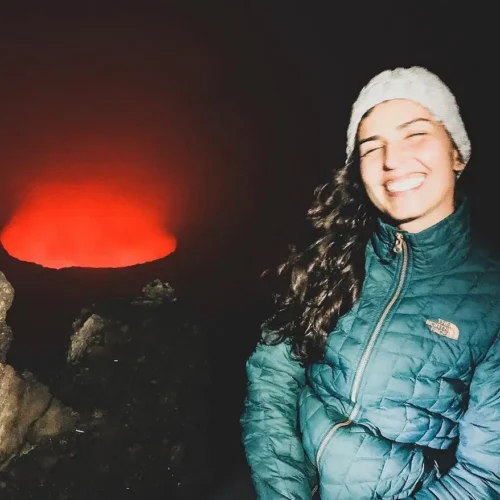
Mountain trekking in the Democratic Republic of the Congo focuses on the dramatic volcanic terrain of Virunga National Park. The primary attraction is Mount Nyiragongo, a 3,470-meter active volcano famed for hosting one of the world’s largest fluid lava lakes. The trek to the crater rim takes roughly four to six hours, climbing through tropical forest and open lava fields, with hikers spending the night in small cabins directly on the rim to view the glowing lava after dark. For alpine hikers, the DRC side of the Rwenzori Mountains also offers a steep, wild ascent to Peak Albert from the Mutwanga trailhead, though this route is far less developed than Uganda’s side.