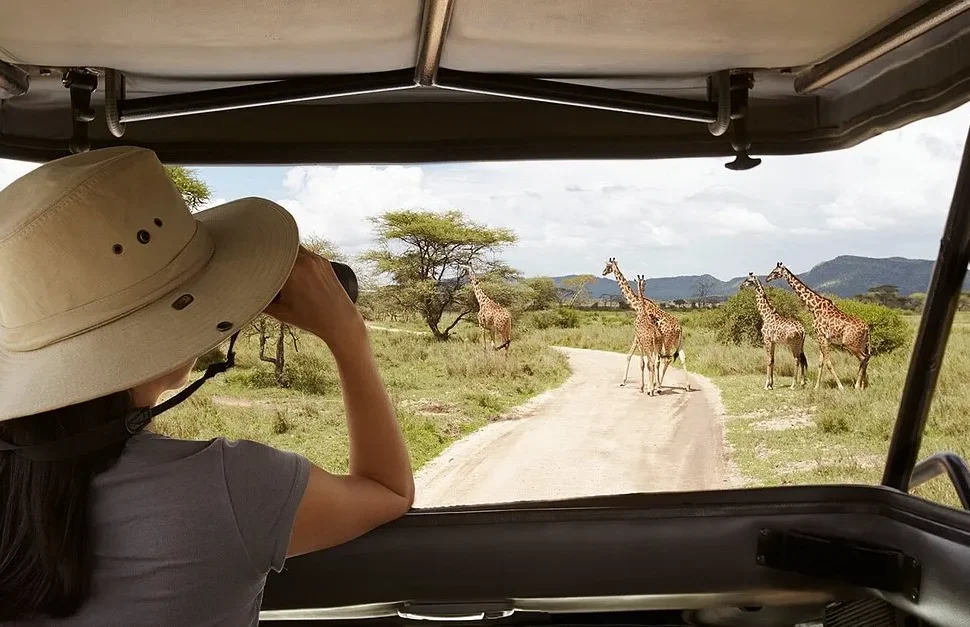
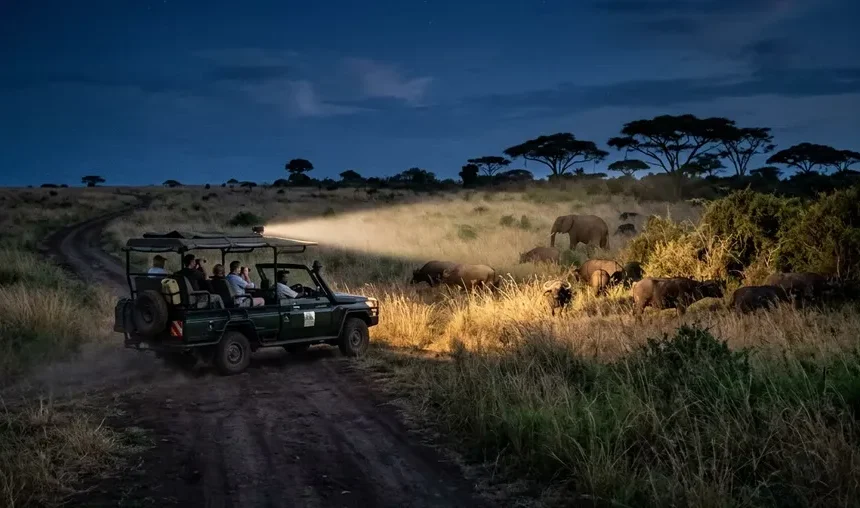
The bush changes after sunset. Tracks that looked empty at 4 p.m. can become hunting routes, hippo paths, and quiet corridors for animals that rarely show themselves in full daylight. That is the appeal of a night game drive: it is a guided safari drive after dark, usually with a Uganda Wildlife Authority ranger or authorised guide, a trained driver, and a spotlight used to scan the edges of the road.
A night drive is not just a daytime safari with less light. In Uganda, the night brings out a different cast of wildlife. Leopards begin to move. Hyenas call across open plains. Genets, civets, bushbabies, porcupines, mongooses, and nocturnal birds become possible sightings. Hippos leave the water to graze. Lions may be more active than they were during the heat of the afternoon.
Sightings are never guaranteed. That is part of the experience. A good night drive is slower, quieter, and more focused on small clues: eye shine in the grass, alarm calls, a shape crossing the track, or the sound of hooves moving through darkness.
Where night game drives are possible in Uganda
Night game drives in Uganda are not allowed everywhere. National parks are protected areas managed by the Uganda Wildlife Authority, and night activities follow park rules. Availability can change because of staffing, conservation rules, road conditions, lodge arrangements, and UWA policy.
The safest advice is simple: confirm night drive availability with UWA or your safari operator before building your itinerary around it. A local operator such as Nturo Safaris can check what is currently possible, which gates or sectors are involved, and whether you need to sleep inside the park or at an approved nearby lodge.
The main destinations to consider are Queen Elizabeth National Park, Murchison Falls National Park, and Lake Mburo National Park. Kidepo Valley National Park may sometimes have special arrangements, but travellers should treat it as case-by-case rather than assuming night drives are always available.
Queen Elizabeth National Park offers strong night safari potential
Queen Elizabeth National Park is one of Uganda’s most popular safari areas, and it is often the first park travellers ask about for night drives. The park has varied habitats, including open savanna, crater areas, wetlands, bushland, and the Kazinga Channel corridor. That variety helps explain why the park supports a wide mix of wildlife.
For night drives, Queen Elizabeth is especially interesting because predators and smaller nocturnal mammals may become active after dark. Leopards are the headline possibility, though they remain elusive. Lions may also be encountered, depending on the area, season, and recent prey movement. Hyenas are often more vocal at night, and their calls can carry far across the plains.
Smaller animals can be just as rewarding. Genets and civets sometimes appear briefly in the spotlight. Bushbabies may be spotted in trees. Porcupines and mongooses are possible, especially along quieter tracks and bush edges.
Queen Elizabeth also fits well into a longer western Uganda safari. From here, many itineraries continue south towards Bwindi Impenetrable National Park for gorilla trekking, or west and north towards other savanna areas. That makes it practical for travellers who want both big game and primates without too much backtracking.
Murchison Falls National Park gives a wild northern feel
Murchison Falls National Park is Uganda’s largest national park and one of its classic safari destinations. It is known for the Nile, the powerful waterfall, open grasslands, borassus palms, and strong populations of savanna wildlife.
Night drives here can feel spacious and wild. The northern bank, with its open plains and woodland edges, is especially known for game viewing during regular daytime drives. After dark, the focus changes from broad herds and distant scenery to movement, sound, and behaviour.
Lions may be more active at night, and hyenas can be heard or seen moving through the plains. Leopards are possible in suitable habitat, though sightings require luck and patience. Hippos often leave the river and water bodies after dark to graze, so guides stay alert on roads and tracks. Night birds may also appear, including owls and nightjars, depending on the route and conditions.
Murchison works well for travellers who want a rounded safari experience. A typical stay can include daylight game drives, a boat trip on the Nile, a visit to the falls area, and, where available, a night game drive. The park’s size means logistics matter, so it helps to choose accommodation carefully and confirm the night-drive sector before arrival.
Lake Mburo National Park is compact and rewarding after dark
Lake Mburo National Park is smaller than Queen Elizabeth and Murchison Falls, but that can be an advantage. It is easier to combine with road transfers between Kampala, Entebbe, and western Uganda. Many safari routes use Lake Mburo as a first or final wildlife stop, especially when connecting to Bwindi or Mgahinga.
The park has woodland, open grassland, lakes, and rocky outcrops. It is well known for zebra, impala, eland, buffalo, and many bird species during the day. At night, the focus often shifts to animals that are harder to see in sunlight, such as bushbabies, genets, civets, porcupines, and nocturnal birds.
Lake Mburo is also one of the more practical parks for travellers with limited time. A night drive here can add a fresh wildlife experience without requiring a long detour. It is not the place to expect the same scale of predator viewing as larger parks, but it has a quiet charm and strong chances for smaller nocturnal species.
Because Lake Mburo lies closer to major travel routes than many Ugandan parks, it can be a smart choice for a short safari extension. For example, travellers returning from gorilla trekking in Bwindi can stop in or near Lake Mburo before continuing to Entebbe.
What about Kidepo Valley National Park
Kidepo Valley National Park is remote, beautiful, and among Uganda’s most memorable safari areas. Its open valleys, rugged hills, and dry-country wildlife give it a very different character from the western parks.
Night game drive arrangements in Kidepo should be checked carefully before travel. In some periods, special activities may be possible through UWA or lodge-linked arrangements, but this is not something to assume. The park’s remoteness, staffing, road networks, and conservation rules can affect what is offered.
If a night drive is a major reason for visiting Uganda, it is safer to plan around Queen Elizabeth, Murchison Falls, or Lake Mburo, then treat Kidepo as a special case to confirm directly.
Wildlife you may see on a Uganda night safari
The main reason to book a night drive is not just to see more animals. It is to see different behaviour.
During the day, many predators rest. The light is better for photography, but heat can slow wildlife activity, especially in the middle of the day. After sunset, temperatures drop and many animals begin to move.
Possible night sightings in Uganda include:
- Leopards Often the most hoped-for night sighting. They are solitary, quiet, and naturally hard to find, so patience matters.
- Lions Lions may hunt, patrol, or call at night. Sightings depend heavily on location and recent prey movement.
- Hyenas Their calls are one of the great sounds of an African night. They may be seen trotting along tracks or scanning for food.
- Genets and civets These small carnivores are usually easier to spot at night than during the day, often by eye shine.
- Bushbabies Watch tree lines and branches. Their large reflective eyes can show clearly in a spotlight.
- Porcupines and mongooses These smaller mammals are easy to miss unless the drive is slow and the guide is alert.
- Hippos Hippos often graze on land at night, sometimes far from water. Guides treat them with great respect because they can be dangerous.
- Nocturnal birds Owls, nightjars, and other species may be found along roadsides or in open areas after dark.
No responsible guide should promise a specific animal. Night drives are about possibility, not certainty.
Day safaris and night safaris feel very different
A daytime game drive is usually better for scenery, photography, and seeing larger numbers of animals. You can scan wider areas, identify birds more easily, and enjoy the full shape of the landscape. In Uganda, morning and late afternoon drives are often productive because animals are active and the light is softer.
A night game drive is narrower in focus. Visibility depends on the spotlight and vehicle position. Photography is harder, especially without specialist equipment. The drive may cover less distance because the vehicle moves slowly.
The reward is atmosphere and behaviour. You listen more. You notice the direction of alarm calls. You watch the guide read fresh tracks in dust or mud. A pair of eyes in the grass can become a genet, a hare, or nothing at all by the time the vehicle stops.
For most travellers, the best approach is to do both. Use daytime drives for broad wildlife viewing, then add one night drive for nocturnal species and a different mood.
What to expect during a night game drive
A typical night drive starts around dusk or after dinner, depending on park rules, lodge location, and UWA arrangements. Exact timing should be confirmed when booking.
The vehicle may be an open-sided safari vehicle or a pop-up roof 4×4. What matters most is that it is suitable for park tracks and guided by people who understand night driving in wildlife areas.
The ranger or guide plays several roles:
- They help interpret animal behaviour.
- They control or direct the spotlight responsibly.
- They decide when to stop, wait, or move on.
- They keep the vehicle at a safe distance from wildlife.
- They follow UWA rules on routes, timing, and conduct.
The drive is usually slower than a daytime safari. The guide may stop often to listen. Silence can be useful. A distant lion call, a hyena whoop, or the alarm call of antelope can change the direction of the drive.
The spotlight is used to scan vegetation and road edges. Good guides avoid shining it harshly into an animal’s eyes for too long. The aim is to observe without stressing wildlife.
Safety and UWA rules matter
Night drives are controlled for good reason. Darkness changes risk. Animals can be harder to read, roads can be more difficult, and visitors have less ability to see what is around the vehicle.
Basic safety rules include:
- Stay seated in the vehicle unless the ranger or guide says otherwise.
- Keep hands and cameras inside when close to wildlife.
- Do not use flash directly on animals.
- Keep voices low.
- Follow the ranger’s instructions without debate.
- Avoid sudden movements when near elephants, buffalo, hippos, or predators.
UWA requirements can vary by park and can change. In many cases, a UWA ranger or authorised guide is required for night activities. The drive may need to be booked through UWA, through a lodge, or through a licensed safari operator.
Accommodation logistics also matter. Some parks or activity arrangements may require visitors to stay inside the park, or at least close enough to meet gate and timing rules. Do not assume you can sleep far outside the park, arrive after dark, and join a drive. Ask this when booking:
Do we need to stay inside the park or at a specific lodge to do the night game drive?
Also ask who provides the vehicle, who provides the ranger, where the drive starts, and what happens if weather or road conditions make the activity unsafe.
Which park is best for a night game drive in Uganda
There is no single best park for every traveller. The right choice depends on the wider route, the wildlife focus, and the time available.
| Park | Best fit | What to keep in mind |
| Queen Elizabeth National Park | Travellers combining savanna wildlife with a western Uganda route towards Bwindi | Good variety of habitats and strong chances for a broad night experience, but arrangements must be confirmed by sector |
| Murchison Falls National Park | Travellers wanting a classic big-park safari with the Nile, boat trip, and open plains | Excellent overall safari destination, but distances inside the park can affect logistics |
| Lake Mburo National Park | Travellers with limited time or those linking Entebbe, Kampala, and gorilla trekking routes | Compact and practical, especially good for smaller nocturnal species, but not as predator-focused as larger parks |
Queen Elizabeth is often the most convenient choice for travellers heading to or from Bwindi. Murchison feels bigger and wilder, especially when combined with the Nile. Lake Mburo is the easiest to fit into shorter itineraries and can be surprisingly rewarding after dark.
The better question is not, “Which park is best?” It is, “Which park fits the rest of the safari without rushing the experience?”
Combining a night drive with gorilla trekking
Many Uganda itineraries combine savanna parks with gorilla trekking in Bwindi Impenetrable National Park or Mgahinga Gorilla National Park. This works well because the experiences are completely different.
A gorilla trek is done on foot, usually in montane forest, with strict rules to protect the gorillas and visitors. A night game drive takes place in a vehicle, in savanna or woodland habitat, with a focus on nocturnal wildlife.
A balanced route might include:
- Murchison Falls for big game, the Nile, and possibly a night drive
- Queen Elizabeth for the Kazinga Channel, daytime game drives, and a night drive where available
- Bwindi or Mgahinga for gorilla trekking
- Lake Mburo as a final wildlife stop on the way back to Entebbe
Nturo Safaris, as a local Uganda operator, can help check current UWA arrangements, match the right park to the route, and avoid booking a night drive where the timing or accommodation does not work.
Practical tips before booking
Book early, especially in peak travel months, because night drives may depend on ranger availability and lodge scheduling. Always confirm the activity close to travel as well, since weather, road conditions, or park instructions can affect plans.
Choose accommodation with logistics in mind. A beautiful lodge far from the starting point may not be practical for a night activity. Ask how long it takes to reach the meeting point after dark and whether park gate rules affect the plan.
Wear muted, comfortable clothing. Nights can feel cool, especially after a warm day, so carry a light fleece or jacket. Avoid bright white clothing if possible, as it stands out strongly in the vehicle and in spotlight conditions.
Carry binoculars. Many travellers assume binoculars are only useful by day, but they can help at dusk, in moonlight, and when viewing animals just beyond the beam of the spotlight. A small pair with good light-gathering ability is better than none.
For photography, keep expectations realistic. Low light, vehicle movement, and animal movement make sharp images difficult. Put the camera down sometimes and enjoy the sounds.
A small checklist helps:
- Warm layer or light jacket
- Binoculars
- Camera with low-light settings, if you plan to shoot
- Insect repellent
- Closed shoes
- Reusable water bottle
- Patience
Final thoughts on night game drives in Uganda
Night game drives in Uganda add depth to a safari because they show a side of the bush that daylight hides. Queen Elizabeth, Murchison Falls, and Lake Mburo are the main parks to consider, while Kidepo should be checked case by case. The best choice depends on the route, accommodation, current UWA arrangements, and the kind of wildlife experience you value most.
Plan it as one part of a wider safari, not as a stand-alone guarantee of rare sightings. With the right guide, a legal arrangement, and a bit of luck, the quiet after sunset can become one of the most memorable hours of the journey.